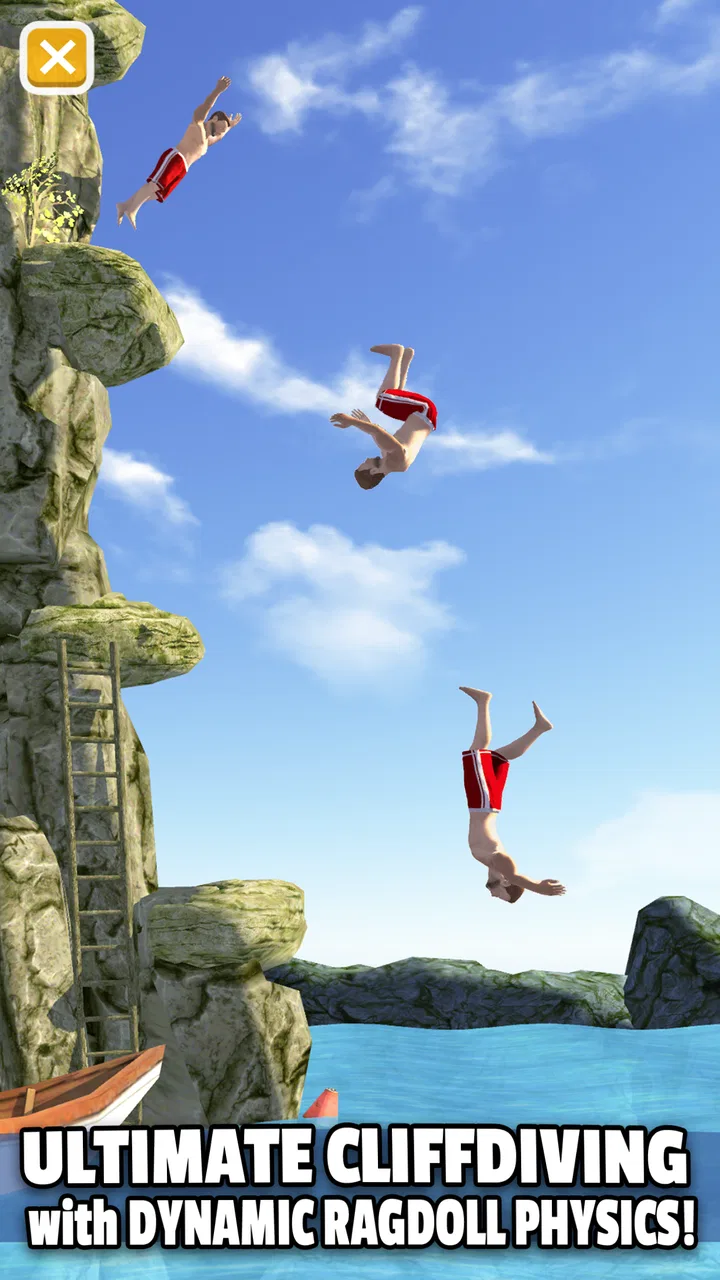
Flip Diving
- 4.5
- Rating
- 100.00M
- Installs
- Free
- Price

 Analysis by App-foxy
I first picked up Flip Diving expecting a quick sports game for filling a few spare minutes, and that is exactly where it works best. It turns a cliff edge, a diver, and a simple control scheme into a surprisingly demanding attempt to land cleanly. The idea is easy to understand: launch from a height, perform flips and stunts, then enter the water without making a painful-looking mistake. The challenge comes from timing, not from a complicated rulebook.
MotionVolt Games Ltd built this as a free sports game for Android and iOS, and its appeal is easy to see. It is lightweight in concept, quick to restart, and entertaining even when a run lasts only a short time. At the same time, it is not merely a button-tapping toy. The physics make every jump feel slightly different, and a move that looks perfect in the air can still end badly if the entry angle is wrong.
After spending time with Flip Diving, I would describe it as a reflex game disguised as a diving game. You are not managing a full athlete career or competing in a detailed simulation. You are learning how to read momentum, choose a sensible moment to rotate, and stop showing off before the landing becomes impossible. That narrow focus is its biggest strength, although it also explains why some players may run out of patience.
You May Also Like

 AccuWeather: Weather Radar
AccuWeather Review: A Quick, Clear Forecast for Everyday Decisions
For everyday plans, the best forecast is the one you can understand quickly. AccuWeather makes rain timing, radar, and local conditions easy to act on, with a few trade-offs.

 Hill Climb Racing
Why Hill Climb Racing Still Turns Crashes Into One More Run
A tiny car, a bumpy hill and one more upgrade: Hill Climb Racing keeps resurfacing because its simple chaos makes every near-miss feel personal.

 AliExpress - Shopping App
AliExpress Makes Global Shopping Feel Personal, but Shoppers Bear the Risk
AliExpress turns a global marketplace into a pocket-sized discovery engine. Its reach is useful, its shopping loop compelling, and its trade-offs easy to miss.

 Lords Mobile: Kingdom Wars
Lords Mobile Is a Kingdom-Building Routine, Not a Quick Match
A case-by-case verdict on the building, battles, device demands, and social commitments that make Lords Mobile rewarding for some players and exhausting for others.

 PDF Scanner app - TapScanner
TapScanner Makes Paperwork Easier to Capture, Check, and Share
TapScanner makes scanning with a phone feel less like a rescue operation and more like a dependable step in getting work done. Its capture tools are useful, though not flawless.

 Block Blast!
 Shows How Much a Puzzle Game Can Leave Out
A quiet grid game shows why puzzle players increasingly value instant clarity, repeatable skill and low-pressure play—and where the genre still needs to catch up.
More From Our News Desk
View All News


How I play it effectively from the first jump
I focus on building a repeatable routine before attempting elaborate stunts: watch the takeoff, make one deliberate adjustment, and judge the entry rather than chasing extra rotation. That gives each restart a clear purpose and makes it easier to spot whether timing or the starting position caused a miss. Once a basic dive feels reliable, I can raise the ambition without turning every jump into guesswork.
A simple baseline workflow makes each attempt more useful
My usual routine starts with a calm first jump rather than an ambitious stunt. I watch how the diver leaves the platform, notice the amount of rotation available, and concentrate on entering the water safely. This sounds cautious, but it prevents a common mistake: treating every launch as an invitation to perform the most complicated move immediately.
The controls are approachable, yet the timing takes practice. Holding or tapping at the wrong moment can change the diver’s position quickly, so I try to make each input with a purpose. Early in a run, I focus on starting the rotation. Later, I focus on releasing or changing the movement soon enough to straighten the body. The exact rhythm depends on the jump, which is why repeating the same action without watching the result rarely helps.
A useful habit is to judge the landing before judging the trick. If the diver is already too low or too far forward, I stop trying to rescue the score with another flourish. A clean, modest entry teaches me more than a spectacular failure because I can identify which part of the timing worked. This is one of the game’s quiet lessons: consistency is more valuable than a lucky-looking jump.
The game suits short sessions particularly well. I can play while waiting for a coffee, take a few attempts during a break, and put it down without needing to remember a long storyline or a complicated objective. Restarts are part of the rhythm, so a failed dive does not create much friction. For a longer session, however, I need to set a small personal goal, such as improving the quality of entries or learning one move, otherwise the repeated attempts can begin to feel similar.
What I check before trying to improve a run
There is no need to approach this like a traditional sports simulator with a large collection of menus. The important preparation is practical: make sure the game responds comfortably on the device, keep the screen clear enough to see the diver, and avoid playing with a finger position that blocks the action. Because timing is central, even a small distraction can make a jump feel unfair when the real problem is simply late input.
I also pay attention to the current version shown for the game. The listed version is 4.6.10, and the title supports devices running Android 6.0 or later. That makes it accessible on a broad range of older phones, although smooth response still depends on the individual device. If the game feels inconsistent, I would first check whether other apps are consuming attention or performance before blaming the physics.
The age guidance is Everyone 10+, which matches the tone of the game in my experience. The action is cartoon-like and focused on stunt failure rather than realistic injury, but younger players may still need help with the idea that repeated failure is part of learning. It is a good choice for someone who enjoys experimenting, not necessarily for a child who expects every attempt to succeed quickly.
Settings and spending deserve a quick look
Since the game is free to download, I can try the core experience without paying first. That is important here because the basic appeal is easy to judge within a short session: either the timing-based diving feels satisfying to you or it does not. The game also includes optional in-app purchases priced from $0.99 to $9.99 per item, so I would review those choices before allowing a child to play unsupervised.
I do not think spending is necessary to understand why the game works. The main skill remains the same: controlling the diver through the jump and making a good entry. Purchases may be tempting for players who want to progress more quickly or access more variety, but they do not replace the practice needed to control a stunt. My advice is to play several short sessions first and decide whether the repetition still feels enjoyable before buying anything.
The game’s store summary emphasizes trick cliff dives, backflips, stunts, doubles, and physics. In practice, the physics are most useful when treated as feedback rather than as decoration. Watch the body’s position, observe how quickly it rotates, and use the next attempt to adjust one part of the movement. If you change everything at once, you will not know whether the improvement came from the launch, the rotation, or the final entry.
Faster patterns that help without turning play into guesswork
Experienced play is less about frantic inputs and more about repeating a reliable sequence. I begin with the launch, decide whether the jump has enough height for a particular stunt, and then commit to that plan. If I start changing direction randomly in the middle of the dive, I usually lose control. A clear plan gives me a reference point even when the attempt fails.
One useful pattern is to separate the jump into three visual moments. First, I watch the takeoff and the initial body position. Second, I check whether the rotation is developing at the expected pace. Third, I prepare for the water entry instead of squeezing in one extra turn. This approach makes the game feel less like guessing and more like a small sequence of decisions.
I also avoid trying to improve both distance and style in the same attempt. A higher or more difficult launch may demand different timing from a safer one. When I am learning, I concentrate on landing cleanly from a familiar position. Once that feels repeatable, I add a more ambitious rotation. This is a practical way to separate skill development from luck.
Another habit is to use failed attempts as comparisons. If one dive rotates too slowly, I do not immediately copy the input from a successful dive without considering the starting position. Instead, I ask whether the launch was different or whether I held the control too long. The game rewards this kind of observation because the same gesture can produce a different result when the diver begins from another angle.
For someone playing on a phone, I recommend keeping the device steady rather than moving it with the diver. Physical movement does not improve the control, and it makes it harder to maintain a consistent rhythm. I get better results when my hand stays relaxed, my view of the screen remains unobstructed, and I use small, deliberate inputs. That sounds obvious, but it is one of the easiest ways to make attempts more repeatable.
Where the physics are satisfying and where they become frustrating
The best part of the game is the moment when a dive feels earned. A successful entry is not just a result on the screen; it shows that the timing, rotation, and correction came together. The physics give the diver enough movement to make each attempt interesting, while the simple objective keeps the focus on execution.
The same physics can also expose the game’s limits. A player looking for exact competitive control may find the experience less precise than a dedicated sports simulation. The game is built around quick attempts and expressive stunts, not around a full technical model of professional diving. I enjoy that trade-off, but someone who wants measured judging, detailed training drills, or a realistic tournament structure should look elsewhere.
There is also a repetition cost. The basic loop is deliberately narrow, and its charm depends on whether you enjoy refining timing. If you need a constant stream of new objectives, story scenes, or team management, the format may feel thin. I would skip it if my main goal were a deep sports career mode. I would choose it when I want a focused challenge that can start and stop immediately.
Advanced play means knowing when not to push
The biggest step from beginner to experienced player is learning to abandon a bad idea early. In a game built around stunts, it is tempting to keep adding rotation because the dive looks impressive. In reality, the final part of the movement matters more than the beginning. If the diver cannot reach a safe entry position, an extra trick is only making the failure more dramatic.
I treat the water entry as a deadline. Once the diver is close enough that there is no realistic time for a correction, I stop experimenting and prepare for the best possible finish. This mindset reduces wasted attempts and makes improvement easier to measure. It also helps answer a question new players often have: should every jump be maximized? In my view, no. The best choice depends on whether you are learning, building confidence, or chasing a personal high point.
Another advanced trade-off is choosing a move that is repeatable over one that is merely possible. A difficult stunt may succeed once and fail several times, while a simpler move can produce steady progress. I use the harder option when I am specifically practicing it, not as my default choice. That keeps the game challenging without turning every session into a string of uncontrolled resets.
I would also keep expectations realistic about the game’s depth. Its large audience shows that the compact format has broad appeal: it has a 4.5 average from around 963 thousand ratings and more than 100 million installs. Those figures suggest a well-established mobile sports game, but popularity does not change its central design. It remains a focused stunt-diving experience, so the right question is whether that loop suits you rather than whether it can replace every other sports game.
Who will enjoy it, and who should choose another game?
I recommend it to players who like physics-based challenges, short arcade sessions, and the satisfaction of making a difficult action reliable. It is especially suitable for someone who enjoys retrying a jump with one small adjustment. The free entry point makes it easy to test, and the simple controls mean you do not need to study a long tutorial before understanding the goal.
It is also a good fit for casual players who want something more interactive than a passive time-killer. A realistic everyday use is a short waiting period: I can complete a few dives, notice one timing mistake, and stop after a clean attempt rather than feeling forced to finish a level or mission. That makes it more convenient than many larger sports games, which often ask for longer sessions or more menu management.
I would not recommend it as the main choice for players seeking online competition, detailed athlete customization, or a broad collection of sports. The experience does not become a full diving simulator simply because the jumps use physics. If you prefer racing, team tactics, or a career structure, another sports title will offer more variety. If you dislike repeating a failed action until your timing improves, the central loop may feel irritating rather than rewarding.
Compared with a conventional sports game, this one removes almost everything except the moment of execution. That gives it a faster start and a lower learning barrier, but it also removes the context that makes a season or tournament meaningful. Compared with a generic endless arcade game, it offers more physical feedback because the diver’s position matters throughout the jump. The trade-off is that its variety comes from mastering movement, not from constantly changing activities.
My verdict after learning the rhythm
Flip Diving works because it keeps the promise of a quick stunt game while giving careful players enough control to improve. I like that a failed dive usually points toward a practical adjustment: begin the rotation differently, stop earlier, or choose a safer move. The game does not need a complicated interface to create tension. The water is always waiting, and the final position matters.
MotionVolt Games Ltd has made a sports game that is easy to start but not instantly easy to master. It is free, rated Everyone 10+, and the current version is 4.6.10, with support beginning at Android 6.0. Those details make it a convenient recommendation for many mobile players, while the optional purchases are a reason to check spending controls before handing over the device.
My strongest recommendation is to play it with a repeatable routine: begin conservatively, watch the diver rather than guessing, change one input at a time, and stop adding tricks when the landing is already at risk. That approach reveals the game’s real appeal much faster than random button presses. The most satisfying progress comes from turning one lucky dive into a repeatable one.
In the end, I see this as a focused arcade sports game rather than a complete diving simulation. I would install it for short sessions, physics-based experimentation, and the pleasure of improving a tricky landing. I would pass if I wanted deep career systems or broad competitive variety. For the right player, though, its narrow design is an advantage: it lets one clean entry feel like a genuine achievement.
FAQs for Flip Diving
01What is Flip Diving and how does it work?
Flip Diving is a thrilling mobile game available for Android and iOS where players perform daring flips and dives from various heights. The objective is to execute perfect dives while avoiding obstacles and earning points. Players can choose different characters and dive spots, adding variety and fun to the gameplay.
02Is Flip Diving free to download and play?
Yes, Flip Diving is free to download from both the Google Play Store and the Apple App Store. While the game is free to play, it does offer in-app purchases. These purchases can enhance the gaming experience by unlocking additional characters or dive locations, but they are entirely optional.
03What are the system requirements for Flip Diving?
Flip Diving requires Android 4.1 or later and iOS 8.0 or later, making it compatible with most modern smartphones. The game is lightweight, so it won’t take up much storage space. However, ensuring your device has enough free space and is updated to the latest software version can enhance performance.
04Does Flip Diving offer multiplayer functionality?
Currently, Flip Diving does not support direct multiplayer gameplay. However, players can compete with friends by comparing scores on leaderboards. This feature adds a competitive edge as players strive to achieve the highest scores and unlock new achievements.
05Are there any tips for improving my performance in Flip Diving?
To improve your performance in Flip Diving, focus on timing your flips accurately to ensure clean entries into the water. Experiment with different characters as each has unique abilities. Practice frequently to perfect your dives and aim to collect coins to unlock new features and enhance your gaming experience.
Pros
- Realistic physics enhance gameplay immersion.
- Wide variety of diving locations to explore.
- Simple controls make it easy for all ages.
- Character customization adds a personal touch.
- Offline play available for entertainment anytime.
Cons
- Frequent ads can disrupt the experience.
- Limited free content; in-app purchases required.
- Can become repetitive after extended play.
- Occasional lag on older devices.
- No multiplayer mode for competitive play.

Flip Diving
Gallery